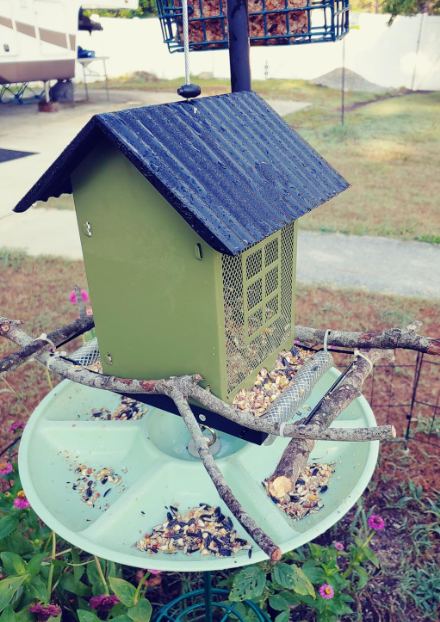
As a special ecological space at the junction of city and nature, the American courtyard not only provides convenient artificial feeding and arboreal habitats for birds, but also hides survival challenges such as food competition, natural enemy threats, and reproductive pressure. These regulars in the courtyard - from jumping dark eyed buntings to agile blue jays, from noisy house sparrows to vigilant Cooper's eagles - have never had the consciousness of "self reflection" like humans, but in millions of years of natural selection, they have evolved a sophisticated mechanism to transform "inner troubles" (such as hunger anxiety, fear of predators) and "instinctual desires" (such as reproductive impulses, territorial possessiveness) into survival motivation. Their behavioral logic is essentially a set of "natural algorithms" that directly convert physiological and environmental pressures into action commands. Every flapping, pecking, and chirping is a concrete expression of tension transformation.
1、 Hunger Anxiety: Transforming 'Survival Panic' into Efficient Foraging Strategies
For courtyard birds, "hunger" is the most fundamental physiological distress. This anxiety caused by energy shortage has not been transformed into disordered agitation, but has become a precise foraging motivation through genetically encoded behavioral patterns. Taking the common dark eyed bunting as an example, these small-sized songbirds need to consume food equivalent to one-third of their body weight every day to maintain body temperature and activity. Hunger triggers the neural signals of their "foraging center" in the brain, driving them to develop an efficient strategy of "zone search+memory caching": they will divide the courtyard into different areas such as lawn, flower bed, and feeder area, and explore them one by one in a fixed order to avoid wasting energy on repeated searches; When discovering high protein foods such as sunflower seeds, if one is unable to fill their stomach immediately, they will quickly peck up the seeds, stuff them into their crop, and then fly them to hidden bushes for storage - this behavior of "instant collection+delayed consumption" is a direct manifestation of transforming "fear of hunger" into "planned foraging motivation".
The larger blue raven, on the other hand, exhibits a more complex "anxiety motivation" transformation logic. Their "possessiveness" towards food is essentially an early anxiety about "winter food scarcity", which drives them to develop amazing "food storage memories": research has found that a blue Jay can store over 30000 pine cones or seeds in autumn, hidden in the bark crevices, shallow soil layers, and even under roof tiles in the courtyard, and can accurately retrieve more than 80% of its stored food months later with visual markers and spatial memory. This ability to transform "future survival anxiety" into "current food storage actions" gives them an advantage in the fiercely competitive courtyard of food.
2、 Natural Enemy Fear: Transforming 'Death Threats' into Defense and Vigilance Systems
The American courtyard is not a safe 'bird paradise', as raptors such as peregrine falcons and Cooper's eagles often lurk at the top of trees or utility poles, and domestic cats are the 'invisible killers' of ground moving birds. The fear of "enemy raids" did not cause birds to fall into a sustained state of stress, but instead gave rise to a clearly defined "vigilance defense" dynamic system, among which the "group vigilance mechanism" of the domestic sparrow is the most typical.
The Vermilion Bird is accustomed to foraging in groups of 10-20 individuals on the lawn in the courtyard. There are always 1-2 individuals in the group who maintain a standing posture and frequently rotate their heads to observe their surroundings. The brains of these "sentinel birds" are constantly in a highly alert state due to the continuous secretion of "fear hormones" (adrenaline). Once they detect the shadow of raptors or the trace of domestic cats, they will immediately emit sharp "warning calls". This kind of chirping is not only a "danger signal", but also a direct "action command": members of the group who hear the signal will immediately stop pecking, either quickly fly into dense bushes to avoid, or collectively fly to high altitude to form a "dispersed flight group", disrupting the attack targets of natural enemies through chaotic flight trajectories. Here, the fear of death has not been transformed into a scattered chaos, but has become an efficient driving force for group survival through the chain of "sentinel division of labor+signal transmission+collaborative defense".
Even solitary Karoo reed wrens can transform their fear of natural enemies into an active drive for defensive modification. These small birds, with a body size of only about 10 centimeters, choose to build their nests in areas close to human activities in the courtyard (such as near balcony flower pots or under porch light racks) - they are well aware that "human activities can indirectly drive away raptors and domestic cats", and this desire for a "safe environment" is essentially a reverse response to the "threat of natural enemies". When building a nest, they will deliberately face the nest towards the wall or dense branches and leaves to reduce the risk of being attacked from the side; Fine plastic ropes, yarn and other materials discarded by humans will be mixed into the nest material, which not only enhances the toughness of the nest, but also slightly interferes with the tracking of reptiles such as snakes through the "smell of non natural materials". This kind of wisdom that transforms "fear" into "environmental transformation" allows them to successfully reproduce in the courtyard surrounded by natural enemies.
3、 Reproductive desire: Transforming the 'genetic pressure' into the ultimate investment in courtship and chick rearing
For birds, "reproduction" is a core instinct that goes beyond individual survival, and the limited space in American courtyards (such as the number of trees suitable for nesting and open areas available for mate display) intensifies the competition for reproduction. This "genetic pressure" and "desire for successful mating" together drive birds to exhibit far greater mobility and creativity than they do on a daily basis.
The Baltimore oriole's "courtship display" is a classic example of transforming "reproductive desire" into visual and auditory dynamics. During the spring breeding season, the feathers of male orioles change from dark yellow in winter to bright orange red. This color change itself is a physiological signal driven by the "reproductive hormone" (testosterone), and their courtship behavior is more ceremonial: the male bird will choose the highest branch or top of a utility pole in the yard and first emit a crisp song lasting for more than 20 seconds (with a sound intensity three times that of daily calls) to attract the attention of females; After the female approaches, it will spread its wings and tail feathers, perform a "spiral flight" around the female, and constantly pick up materials such as branches and petals to "offer gifts" to the female. This display behavior, which consumes a lot of energy, essentially transforms the "desire for reproductive opportunities" into the driving force of "visual attraction+resource proof", proving its health status and nesting ability through extreme performance, and thus winning the right to mate.
The "brooding behavior" in the later stage of reproduction is the process of transforming the "parent-child instinct" into high-intensity labor. Taking the North American mockingbird as an example, the female bird needs to incubate for 12-14 days after laying eggs. During this period, the male bird will undertake a dual task of "foraging, feeding, and territorial defense": before dawn every day, the male bird will fly out of the courtyard and capture high protein foods such as earthworms and beetles in the surrounding grassland. On average, it travels back and forth to the nest 3-4 times per hour, and the daily flight distance can reach more than 10 kilometers; If other birds approach the nest, the male bird will immediately launch an attack, even when facing larger blue jays without flinching. The "high-intensity foraging and defense motivation" transformed by this "brooding pressure" directly determines the survival rate of chicks - studies have shown that in courtyards with sufficient food, couples of mockingbirds who invest more time in brooding can achieve a survival rate of 70%, much higher than the 40% in the wild environment.
4、 Territorial competition: Transforming the desire for exclusive resources into a driving force for border protection
The limited resources of American courtyards, such as fixed feeders and tree holes suitable for nesting, make "territorial possession" a key factor for bird survival, and the problem of "territorial invasion" directly translates into the driving force of "border protection", which is particularly evident in the main Cardinals.
The male main Cardinals have a strong desire to monopolize their territory. They mark their territory in two ways: one is by continuously singing on the branches at the boundary of the territory. The frequency and volume of this singing increase as the breeding season approaches, essentially "declaring sovereignty through sound" and transforming the "desire for territory" into "auditory signal dynamics"; The second is to deter intruders through visual display - when other male main cardinals approach their territory, the defender will immediately raise the feathers on their heads, spread their wings, and assume an attacking posture. If the intruder does not retreat, they will launch a fierce attack, pecking at their head and wings with their beak until they are driven away.
What's even more interesting is that the main Cardinals also include "human activities" as part of their territorial resources - they remember the body size and movements of humans they frequently feed, are not guarded against "friendly humans", and even wait next to feeders; But for unfamiliar humans or pets who frequently shake tree branches, it will be considered a "territorial threat" and warning calls or brief attacks will be launched. This "precise judgment of territorial resources" allows them to transform the "troubles of territorial competition" into "differentiated guardianship power", avoiding unnecessary energy consumption while ensuring the monopoly of core resources.
Conclusion: Wisdom of "Tension Transformation" under Natural Selection
The courtyard birds in the Americas have never "actively controlled" their inner troubles and desires. Their behavioral logic is the "optimal survival strategy" selected by natural selection - hunger anxiety drives efficient foraging, fear of natural enemies creates a warning system, reproductive desire stimulates brooding investment, and territorial competition strengthens border protection. Behind these seemingly instinctive behaviors is a precise closed loop of "pressure motivation" transformation: troubles and desires are not "suppressed", but directly transformed into concrete action instructions. The success of each action (such as capturing food, avoiding predators, and nurturing chicks) will be alleviated through physiological feedback (such as energy supplementation, increased sense of security, and genetic continuity), forming a cycle of "action feedback action".
For humans, this natural wisdom may provide another perspective on "inner tension": troubles and desires themselves are not "burdens", but the primitive energy that drives action. The key is to establish a "transformation mechanism" like a courtyard bird - transforming anxiety into planning, fear into vigilance, and desire into engagement. When we observe the jumping lantern bunting and singing main Cardinals in the courtyard, what we see is not only the daily survival of birds, but also the "tension transformation" instinct that natural evolution endows all living beings with - a survival wisdom of finding motivation in difficulties and anchoring direction in desires.
We recommend our Flowafoli bird feeder!