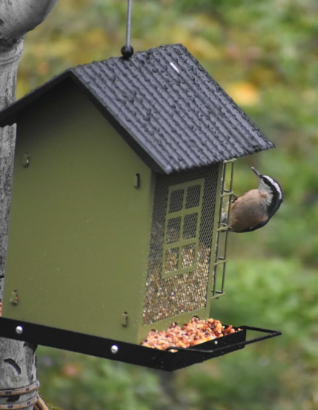
As the intersection of artificial environment and natural ecology, American courtyards provide stable sources of food (such as feeders, fruit shrubs) and nesting sites, as well as unique variables such as human activities and pet interference. Birds living here, such as the main Cardinals, Blue Jays, Swallows, and Thrush, have evolved a precise set of self adjustment strategies through long-term adaptation to balance survival needs and environmental constraints, ensuring regularity and flexibility in their daily routines. This adjustment is not a single behavioral change, but a comprehensive adaptation involving physiological rhythms, behavioral patterns, and sensory applications.
1、 Core regulation: Anchoring basic sleep patterns with endogenous rhythms
The daily routine of courtyard birds in the Americas is primarily dominated by their biological clock (circadian rhythm), which is a built-in "timer" that calibrates various activities by sensing changes in light. Most courtyard birds belong to diurnal species, and their photoreceptor cells in the retina are linked to the pineal gland in the brain. When the light intensity increases in the morning, the secretion of melatonin by the pineal gland decreases, stimulating nerve excitation and promoting bird awakening; When the evening light weakens, it triggers melatonin secretion in reverse, guiding it into a resting state.
This rhythm has inherent stability, but will be adjusted according to the season. For example, the main Cardinals in the eastern part of North America may wake up around 4am in the summer due to prolonged sunlight, in order to avoid the high noon temperatures; In winter, activities are postponed until after 6am and concentrated during the warm noon period. This light based rhythm adjustment is the "basic operating system" for birds to cope with the courtyard environment, ensuring that their core routines are synchronized with the natural day night cycle.
2、 Foraging strategy: dynamically adapting to resources and risks
Foraging is the core driving force for birds to adjust their daily routines, and the distribution characteristics of food in American courtyards (such as regular feeding by humans and the ripening cycle of plant fruits) directly affect the subdivision of their activity periods. Their adjustment strategy can be summarized as a dual logic of "resource tracking+risk avoidance".
1. Accurately match food accessibility
For birds that rely on artificial feeders, such as blue jays and dark eyed buntings, they will form a "conditioned reflex sleep" through observation and memory. If the owner of the courtyard is accustomed to replenishing seeds at 7am every day, these birds will wait in advance on nearby branches, forming a fixed "feeding window"; The thrush, which feeds on berries and insects in the courtyard, will adjust its time slot according to food activity - insects are most active from 5-7 am in summer, and thrushes will concentrate on searching on the lawn during this time; After the autumn berries mature, they shift their peak activity to after 10am, utilizing warm weather to efficiently feed and store energy.
2. Avoid multiple risks in foraging
Human activities in the courtyard (such as sweeping and gardening) and pets (cats, dogs) are the main sources of interference, while birds reduce risks through "time mismatch". For example, house swallows often build nests under the eaves of courtyards. They avoid the peak activity period after human nap time (2-4 pm) and concentrate their time outside to hunt for flying insects between 9-11 am and 5-7 pm; Smaller American goldfinches are more cautious, feeding quickly in the early morning and evening when there is less human activity, and resting in courtyard shrubs at noon to reduce exposure to open feeders.
3、 Breeding period specialization: reconstructing the sleep rhythm for chicks
The breeding season (spring from March to July) is the most intense period for courtyard birds in the Americas to adjust their daily routines. Parent birds will break their regular rhythms to meet the high demand for hatching and raising chicks. This adjustment presents the characteristics of "parental collaboration and segmented time periods".
Taking the common courtyard bird sparrow as an example, the female bird is responsible for the main hatching task. She will briefly leave the nest every 15-20 minutes during the day to forage, and stay in the nest to maintain the temperature of the eggs during the rest of the time. The departure period is often chosen before 10am and after 3pm when human activities are gentle; The male bird takes on the responsibility of "foraging and supply", going out to catch insects at dawn in the morning, concentrating on feeding the female bird in the morning, and expanding the foraging range in the afternoon to reserve the food needed for raising chicks. After hatching, the parents' activity time will be further extended, and they may even continue to hunt at dusk when the light is weak. At this time, they will use the assistance of courtyard lights to improve their hunting efficiency - this temporary use of artificial light sources is a typical manifestation of birds adapting to courtyard environments.
In addition, to avoid the nest being discovered by natural enemies such as squirrels and snakes, parent birds will deliberately adjust the rhythm of returning and leaving the nest, reduce unnecessary nest side activities during peak breeding periods, and minimize rest time. This "rhythm sacrifice" is a key guarantee for successful reproduction.
We recommend our Flowafoli bird feeder!