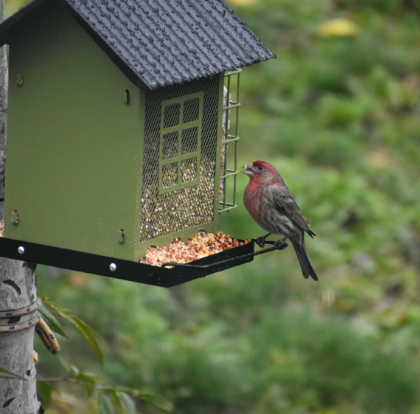
In the intertwined ecological space of artificial and natural courtyards in the Americas, birds often face various "process processing operations" interference - from human daily activities (such as gardening pruning, equipment maintenance) to sudden environmental changes (such as vegetation modification, temporary construction). These disturbances disrupt their original foraging, nesting, and breeding rhythms, and although birds do not have a "mentality" in the human sense, they can dynamically respond to disturbances through a series of precise behavioral adjustments, physiological adaptations, and cognitive decisions. Essentially, this is the survival wisdom formed by species in long-term evolution.
1、 Instant stress: building a safety barrier with "avoidance priority"
When sudden disturbances occur in the courtyard (such as the roar of pruning machines or frequent human movements), the first reaction of birds is to activate the "stress avoidance" mechanism, which is regulated by the nervous system and endocrine system, equivalent to building the "first line of defense" for survival.
Taking the common North American mockingbird (Turdus migratorius) in the courtyard as an example, they are extremely sensitive to high-frequency mechanical noise. When the gardener starts the trimmer, the mockingbird will capture the direction of the sound source through its auditory system within 10 seconds, then spread its wings and fly a short distance away to the top of the tall trees in the courtyard - a position where it can observe the dynamics of the disturbance source through the obstruction of branches and leaves, and quickly evacuate to a safer area. At the same time, its body will briefly secrete adrenaline, increase heart rate and respiratory rate, enhance muscle explosiveness, and reserve energy for possible emergency escape.
The smaller Junco hyemalis, on the other hand, adopts a "concealment strategy": they quickly burrow into the bushes or flower beds in the courtyard, using the density of branches and leaves to conceal their body contours, while contracting their bodies, reducing their range of activity, and even pausing their calls, reducing the probability of being distracted by "lowering their presence". This differentiated immediate response originates from the differences in body size, flight ability, and ecological niche of different birds, but collectively points to the core goal of "minimizing risk".
2、 Behavioral reconstruction: Adjusting activity rhythms to adapt to interference cycles
When disturbances exhibit regularity, such as daily courtyard cleaning and weekly irrigation operations by humans, birds will adjust their activity processes through "behavioral restructuring" to minimize the impact of disturbances on survival, similar to the process of "actively adapting" to the rhythm of disturbances.
In the courtyards along the Gulf of Mexico coast, the foraging behavior adjustment of Thryothorus ludovicianus is highly representative. Local residents often water their courtyards from 9am to 10am in the morning, when the ground is moist, insect activity is reduced, and human activities are frequent. Observations have shown that the Karoo reed wren will advance its original "morning ground foraging" time to 7 to 8 o'clock, avoiding watering periods; After 10 o'clock, the interference will end, and then return to the ground to hunt for soil insects carried out by the water. At the same time, they also increase the proportion of foraging in the shrub layer, by pecking at leaf insects in the shrubs during disturbance periods to maintain stable food intake.
Similarly, in California gardens, Calypte Anna adjusts its feeding rhythm based on human balcony activity time. If humans are accustomed to resting on balconies in the afternoon, hummingbirds will shift the peak period for visiting courtyard flowers to before 10am and after 4pm, avoiding human close range interference while ensuring the efficiency of pollen and nectar collection. This "time staggered" strategy is essentially an adaptive decision made by birds through long-term observation and memory formation of interference cycles.
3、 Spatial migration: reconstructing habitats to reduce disturbance dependence
When disturbances persist in the courtyard (such as long-term construction or large-scale vegetation renovation), birds will initiate a "spatial migration" strategy, reducing their dependence on the disturbed area by adjusting their nesting positions, expanding their range of activities, or changing their habitats. This is a "passive optimization" way of living space.
In residential courtyards in Florida, if a household undergoes long-term roof repairs (lasting 1-2 months), the Hirundo rustica, which originally built its nest under the eaves, will make two choices: one is to relocate the nest site to the grape trellis in the courtyard or the eaves of adjacent houses - these locations are at least 10 meters away from the construction area and can maintain similar rain and shelter conditions; The second is to expand the foraging range, extending from the original foraging area centered around courtyard lawns to surrounding parks, green spaces, or farmland within 500 meters. By increasing the foraging distance, the problem of reduced insect populations in the construction area can be compensated for.
For birds with strong territorial awareness, such as the main Cardinalis cardinalis, spatial adjustment is more "gentle". They will not easily give up their original territory, but instead shift their core activity areas (such as nesting sites and foraging core areas) to undisturbed corners within their territory by reducing their activity frequency in the disturbed area. For example, if vegetation pruning is carried out on the east side of the courtyard, the main Cardinals will shift their focus of activity to the shrubbery and tree areas on the west side, and only briefly enter the eastern area to forage when the disturbance weakens (such as in the evening), maintaining the integrity of the territory and avoiding stress consumption caused by continuous disturbance.
4、 Physiological adaptation: "stress desensitization" and energy regulation under long-term interference
When there is long-term, low-intensity interference (such as continuous human walking in the courtyard or children playing), birds will reduce their sensitivity to interference and unnecessary energy consumption through physiological "stress desensitization" and energy regulation, which is a "long-term adaptation" mechanism.
Research has found that Turdus migratorius, a migratory thrush that has long lived in areas with high human activity in suburban courtyards of New York City, has significantly lower baseline levels of stress hormones compared to its counterparts living in suburban forests. This means that their sensitivity to human activities decreases - when humans move within 5 meters of them, the thrushes in suburban forests immediately fly away, while the thrushes in the courtyard only briefly look up to observe. If no direct threat is found, they continue to forage. This "desensitization" is not a disregard for danger, but rather a judgment of "non threatening interference" formed through long-term exposure, reducing unnecessary stress reactions and saving energy (stress reactions consume a large amount of glycogen and fat, and long-term frequent stress can affect reproduction and survival).
At the same time, these birds that have been in a disturbed environment for a long time will also adjust their energy allocation strategies: they will increase the frequency of food intake (such as shortening the single foraging time and increasing the number of foraging times) to ensure energy reserves; During the breeding season, the number of eggs in the nest will be appropriately reduced (such as from the usual 4 eggs to 3 eggs), and the saved energy will be used to cope with possible disturbances (such as frequent nest protection and repairing disturbed nests), improving the survival rate of young birds. This combination of "energy regulation" and "stress desensitization" allows birds to maintain normal physiological functions and ensure reproductive success rates in long-term disturbed environments.
Conclusion: Ecological Implications Behind Survival Wisdom
The strategy of American courtyard birds to cope with "process processing operations" is essentially the wisdom of species to "dynamically balance survival needs and disturbance effects" in artificial environments. From immediate avoidance to behavioral reconstruction, from spatial migration to physiological adaptation, each strategy is a precise response of birds to environmental changes, and also reflects the possibility of coexistence between humans and wildlife in artificial ecosystems.
For humans, understanding these strategies can not only help us better protect birds in our courtyards (such as reducing large-scale horticultural activities during bird breeding periods and preserving some natural vegetation for birds to inhabit), but also provide inspiration for building a "harmonious coexistence between humans and nature" urban ecology - when we respect the survival needs of wildlife and actively reserve adaptation space for them, cities will become a more dynamic community of life.
We recommend our Flowafoli bird feeder!