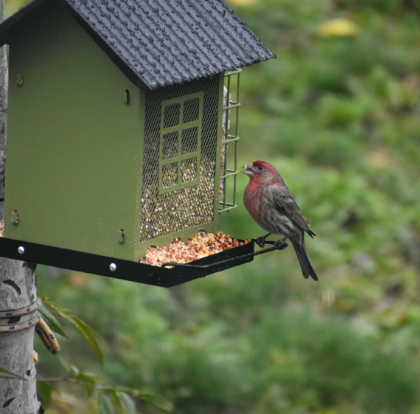
1、 Core environmental signal: "biological clock calibrator" in the courtyard
The ecological characteristics of American courtyards provide precise rhythmic references for birds, with light signals and fluctuations in food resources being the most critical external triggering factors.
1. Lighting: the "main switch" for rhythm regulation
The duration of day and night on the American continent varies dramatically with the seasons (such as up to 16 hours in summer and only 8 hours in winter in temperate North America), and the density of branches and leaves of courtyard trees further shapes local lighting patterns. Cryptochrome in the retina of birds can sense changes in blue light intensity. When sunlight penetrates the branches and leaves of oak or crape myrtle trees in the courtyard in the early morning, the light signal is transmitted through the optic nerve to the suprachiasmatic nucleus (SCN) of the brain - this "biological clock center" will activate the wake-up program: promoting melatonin degradation, stimulating cortisol secretion, and prompting birds to shift from a nocturnal state to active foraging.
2. Food resources: the "practical anchor" of rhythm
The food supply of courtyard ecosystems has clear timeliness:
Daytime peak: In the morning light, earthworms on the courtyard lawn crawl out of the ground due to the decrease in humidity, attracting American Robins to locate and peck at them using their auditory senses; Butterflies and bees in the afternoon flowers are active, providing pollen and insect larvae for the American Goldfinch.
Seasonal adaptation: when the hawthorn trees and Sorbus sorbifolia fruits in the courtyard are mature in autumn, the birds will adjust their work and rest in advance to extend the afternoon foraging time to store energy; When food is scarce in winter, the timed feeding of artificial feeders will become a new rhythm reference, and birds such as the Northern Cardinals will form a fixed "feeding window".
2、 Physiological rhythm mechanism: the "precise timer" in the body
External signals need to be converted into stable rhythms through the internal physiological system, and the regulatory mechanism of birds exhibits a "central peripheral" collaborative feature.
1. Central Rhythm System: The "Command Center" of the Brain
The suprachiasmatic nucleus synchronously regulates the melatonin secretion rhythm of the pineal gland by secreting neurotransmitters such as thyrotropin releasing hormone (TRH)
At night: After the courtyard is completely dark, the concentration of melatonin reaches its peak, inhibiting the activity center of birds and prompting them to seek refuge in dense shrubs or under eaves at night;
Dawn: Melatonin drops sharply, and birds begin to comb their feathers and call to declare their territory. This process forms a "gradient awakening" in American courtyards due to building obstruction - sparrows near the light source become active first, and wrens under the shade of trees become slightly later.
2. Peripheral Rhythm Synchronization: Organ 'Collaborative Response'
There are independent rhythmic genes (such as Clock and Bmal1) in peripheral organs such as the liver and intestines, which need to be synchronized with the central nervous system
1 hour before foraging: The intestine secretes digestive enzymes in advance, which is particularly evident in Cedar Waxwing, which relies on yard berries;
Special adjustment during migration season: In spring, the Swallow in North American courtyards activates a "dual rhythm" to store energy - high-frequency foraging during the day, brief dormancy at night, and a 30% increase in liver glycogen metabolism rate.
3、 Special adaptation strategies for courtyard microenvironment
Compared to their natural habitats, artificial disturbances such as lighting and noise in American courtyards have forced birds to evolve flexible rhythmic adjustment abilities
1. Adaptation to light pollution
The streetlights in suburban courtyards prolong the hunting time of nocturnal Barn Owls by 1-2 hours, and their retinal rod cell density is 15% higher than that of forest populations; The sparrows in urban courtyards form an "early awakening avoidance" - leaving their nests 20 minutes earlier than natural populations to avoid the peak of human activity in the early morning.
2. Resource pulse utilization
The artificial feeder in the courtyard creates a "food pulse", and the Eastern Bluebird will adjust its rhythm: it will focus on feeding within 10 minutes after the feeder is put in place, and then enter the "alert and rest period". This mode is passed to the chicks through the parent bird demonstration, forming the rhythmic memory of the population level.
4、 Rhythm disorders and ecological balance insights
When the courtyard environment disrupts the rhythm synchronization (such as overnight lighting, disorderly feeding), it will trigger a chain reaction:
Mockingbirds lay eggs early due to abnormal secretion of melatonin, leading to an increase in mortality rates for their chicks during the late spring cold season;
The feeding rhythm of hummingbirds is misaligned with the honey secretion period of garden flowers, leading to a decrease in pollination efficiency.
This reminds us that creating a "rhythm friendly courtyard" requires following natural laws, such as using sensor based street lights and regularly dropping food, to create a positive interaction between the bird's biological clock and the courtyard ecology.
We recommend our Flowafoli bird feeder!