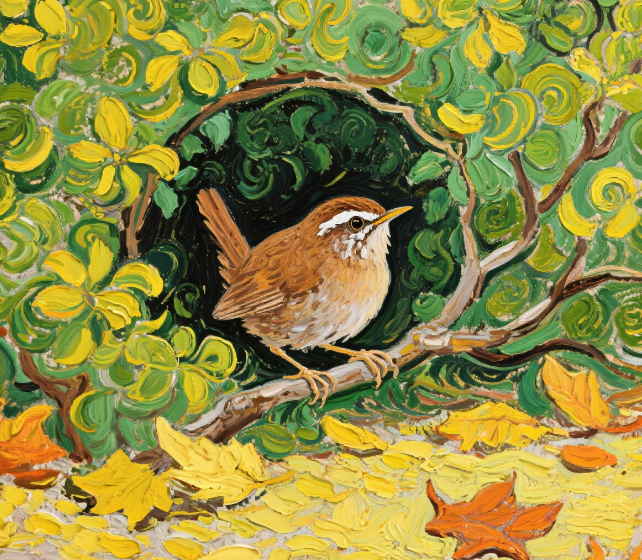
In the courtyards of residential areas across the Americas, there exists a remarkable interplay between birds and the “enclosures” created by human activities. These enclosures encompass both naturally formed structures such as tree hollows and dense shrubbery, as well as artificially created structures like fence gaps, drainpipe openings, and air conditioner unit crevices. Birds do not passively adapt to these environmental obstacles but instead transform them into survival resources through species-specific behavioral patterns and temporal rhythms, demonstrating remarkable ecological adaptability.
I. Utilization of Natural Barriers: Rhythmic Control Aligned with the Breeding Cycle
The most common natural barriers in American gardens are tree cavities formed by trees. Different bird species exhibit strict temporal rhythms in their utilization of such resources. The Northern Cardinal (Cardinalis cardinalis) selects tree cavities with diameters of 5–8 centimeters as nest bases during the breeding season from March to August each year. Male birds repeatedly clean the interior of the cavity using their beaks to remove decaying wood debris, a process typically lasting 3–5 days, concentrated between 6–8 a.m. daily when bark moisture levels are higher, facilitating cleaning. In contrast, the Carolina Wren (Thryothorus ludovicianus) exhibits a markedly different processing rhythm. They prefer to utilize the dense branches of shrubbery as natural barriers. Before nesting, the female repeatedly squeezes the gaps between branches and leaves with her body, adjusting her body angle to expand the internal space. This “body measurement” behavior is repeated 15–20 times daily, each lasting 2–3 minutes, until an elliptical depression suitable for incubation is formed.
For the ground layer formed by fallen leaves, the American robin (Turdus migratorius) has developed a unique processing strategy. During the autumn foraging season, they employ a “three-step digging method”: first, they use their beaks to part the surface layer of fallen leaves (approximately 10 seconds), then they alternately dig into the middle layer of humus soil with their claws (lasting 20–30 seconds), and finally they remain still for 3–5 seconds to confirm if there is any insect activity. This rhythmic action is repeated every 2–3 minutes, ensuring foraging efficiency while avoiding excessive energy expenditure. In winter, when snow forms temporary barriers, the Snow Bunting (Junco hyemalis) adjusts its rhythm, switching to a “jump-flap” cycle where it flaps its wings on the snow surface after each jump to expose seeds through vibration. This cycle is precisely controlled to last around 15 seconds, highly aligned with their metabolic rate.
II. Adaptation to artificial obstructions: adjusting behavioral patterns based on resource characteristics
Facing the diverse obstructed environments created by humans, American courtyard birds demonstrate remarkable behavioral plasticity. When dealing with vertical obstructed spaces like building crevices, the barn swallow (Hirundo rustica) has developed a “segmented nesting method”: First, they use saliva to bind mud at the bottom of the crevice to build a foundation platform (working 4–5 hours daily for 3 days), then gradually expand the nest walls upward (increasing height by 1–2 centimeters daily, adjusting to 2 hours of work in the morning and evening), and finally leave an entrance/exit with a diameter of 3–4 centimeters at the top. This phased rhythm accommodates the time needed for the mud to dry while avoiding energy depletion from prolonged single work sessions.
For linear obstructions like fences and clotheslines, the spotted dove (Spilopelia chinensis) adopts a “minimalist” strategy. When selecting a roosting site, they first land on the target object for a stability test lasting about 30 seconds, assessing support strength through slight body movements, then adjust their claw spacing to match the barrier's diameter (typically 2-3 centimeters), and finally maintain a balanced posture with their body parallel to the ground. This “test-adjust-stabilize” behavioral sequence has been optimized through long-term natural selection, ensuring that the birds can access resting resources while minimizing the risk of falling.
When dealing with temporary obstacles created by human activities (such as piled-up gardening tools or hanging laundry), the Northern Bluebird (Sialia sialis) demonstrates flexible time allocation capabilities. They avoid these areas during peak human activity hours (typically 9 AM to 5 PM) and instead utilize stable resources along the edges of yards; during low-activity periods in the early morning and evening, they quickly traverse these temporary obstacles, strictly limiting each stop to 1–2 minutes. This time allocation strategy ensures foraging needs while minimizing conflicts with humans.
III. Species-specific rhythms: Evolution-shaped behavioral clocks
The rhythms by which different bird species handle obstructions deeply reflect the physiological characteristics and ecological needs formed during their evolutionary history. Hummingbirds (Trochilidae), due to their high metabolic rate, have developed a “high-frequency visitation” strategy when dealing with the tubular structures of flowers: they spend only 0.5-1 seconds on a single flower, using rapid wing vibrations to hover and feed, visiting 20-30 flowers per minute. This extremely fast processing rhythm is perfectly synchronized with their heart rate of 500–900 beats per minute.
In stark contrast, woodpecker species, such as the downy woodpecker (Picoides pubescens), employ an “intermittent impact” mode when processing the woody structures of trees. After 3–5 pecks, they pause for 10–15 seconds, using the special shock-absorbing structure of their heads to cushion the impact while observing the results of the pecking. This “work-rest” cycle ensures efficiency in creating tree holes while avoiding brain injury, with its rhythm closely coordinated with the evolutionary structure of the skull.
In social bird species, such as the common starling (Sturnus vulgaris), the handling of enclosed spaces for group roosting (e.g., chimneys, large tree holes) exhibits collective synchrony. At dusk, they first perform a 5–10-minute group hovering around the roosting site, then enter the enclosed space in batches, with each batch comprising approximately 1/5 of the total group size, spaced 2–3 minutes apart. This ordered entry rhythm avoids congestion at the entrance and reduces predation risks through group behavior, demonstrating the unique rhythmic coordination mechanisms of socialized living.
IV. Environmental Dynamic Responses: Rhythm Adjustments Driven by Seasonal and Climatic Factors
The rhythm of enclosed space processing by American backyard birds also undergoes dynamic adjustments in response to seasonal changes and climatic fluctuations. During the spring breeding season, most birds accelerate the processing rhythm of breeding-related occlusion objects (such as tree holes and dense shrub areas). For example, the American goldfinch (Spinus tristis) extends the daily time spent processing plant fibers to 6-8 hours during the nesting period, which is 2-3 times longer than during the non-breeding period. This rhythm adjustment is directly related to the cyclical changes in reproductive hormone levels.
When facing extreme weather conditions, birds temporarily alter their nesting material processing strategies. During heavy rain, the blue jay (Cyanocitta cristata) reduces its foraging time outdoors and extends its stay in enclosed spaces like tree cavities, shortening each outing to process the external environment from the usual 15–20 minutes to 5–8 minutes; During drought seasons, they increase the frequency of using enclosures near water sources, with daily visitation increasing from 3–4 times to 8–10 times, adjusting time allocation to cope with environmental stress.
Environmental changes brought about by urbanization are also reshaping birds' rhythms in handling enclosed spaces. Research has found that American backyard birds living in urban central areas generally exhibit faster rhythms in handling enclosed spaces compared to their suburban counterparts: urban house sparrows (Passer domesticus) traverse fences 20–30% faster than suburban individuals, and the nesting cycle in artificial nest boxes is shortened by 1–2 days. This urbanization-driven rhythm change represents an important behavioral adaptation by birds to environments with high human activity density.
The rhythm of obstruction-handling behavior in American backyard birds is not a simple random adaptation but a highly coordinated rhythmic system formed through long-term evolution, closely aligned with physiological characteristics, ecological needs, and environmental conditions. From natural tree cavities to artificial building crevices, from breeding seasons to extreme climates, these birds transform various environmental obstacles into survival resources through precise time allocation and behavioral adjustments, demonstrating the remarkable wisdom of life in responding to complex environments. Gaining a deeper understanding of these behavioral patterns and rhythmic mechanisms not only helps us better protect bird diversity in urban ecosystems but also provides valuable ecological insights for humans exploring pathways toward harmonious coexistence with nature.
How birds in the American courtyard deal with obstacles at their own pace
Aug 21, 2025 Bird knowledge presenters