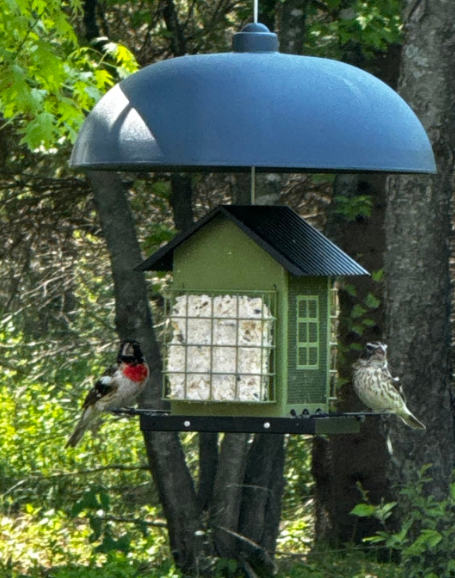
In the courtyard ecology of the American continent, behind the seemingly casual activities of birds lies a sophisticated time management system. From the first cry of dawn to the resting at dusk, these small organisms efficiently allocate multiple survival tasks such as foraging, reproduction, shelter, and migration through precise perception of circadian rhythms, seasonal changes, and resource dynamics. Their time management ability can be regarded as the "miniature precision instrument" of nature.
1、 Circadian Rhythm: Basic Scheduling Centered on Sunlight
The time management of courtyard birds in the Americas is first based on precise tracking of the solar cycle, which is regulated by the "biological clock" in the body and external environmental signals. Taking the common Northern Cardinals as an example, their activity rhythm strictly follows a fixed pattern of "morning chirping - foraging - nap time - foraging again - returning to the nest": at dawn, when the light intensity reaches 10-20 lux, the male bird begins to chirp. At this time, the chirping is not only a declaration of territory, but also a "time calibration" of daily activity - synchronizing the group's schedule through sound signals to avoid individuals missing key foraging periods due to clock deviations.
At noon, the surface temperature of American courtyards often rises above 30 ℃, and most birds enter a "nap mode". For example, Carolina Wren chooses to stay in the shadows of dense shrubs, reducing metabolic rate by 15% -20% and decreasing energy consumption. This behavior is not random, but based on long-term adaptation to temperature changes: they sense the ambient temperature through internal temperature sensors, and when the body surface temperature exceeds 38 ℃, they automatically trigger a "time avoidance mechanism", shifting their active time to cool periods in the morning and evening, maximizing their foraging efficiency while avoiding the risk of heatstroke.
At dusk, when the light intensity drops below 5 lux, birds will start the "countdown to homing". House Finch will finish foraging 30 minutes in advance, visually identifying iconic plants around the nest (such as oak trees and wisteria in the courtyard), accurately calculating the time required for the return route, and ensuring the safety check of the habitat before complete darkness - the control of this time node is crucial, as it can avoid the active period of nocturnal predators (such as owls) and reserve sufficient preparation time for nighttime insulation.
2、 Resource Dynamics: Adjust Time Allocation with Food Changes
The time management of courtyard birds in the Americas is highly dependent on the periodic changes in food resources, forming a flexible strategy of "adjusting according to demand". Spring is the peak season for insect reproduction, for example, the Indigo Bunting will extend its daily foraging time from 4-5 hours in winter to 8-9 hours, and concentrate its foraging time on the most active periods of insects, which are 6-8 in the morning and 5-7 in the evening. At this time, the flight ability of Coleoptera insects is weak, and the probability of being preyed on increases by more than 30%. In order to accurately capture this window period, indigo bunting infers the peak appearance of insects by remembering the flowering time of plants (such as lilacs and daisies in the courtyard), forming a time chain of "plant insect bird" linkage.
When the fruits ripen in autumn, the time allocation of birds will be adjusted again. Cedar Waxwing birds form large groups of hundreds and migrate collectively to berry rich courtyard areas, adopting a "fast feeding short rest" cycle: each bird can peck at 20-30 berries within 10 minutes, then rest for 5 minutes to digest. Through this high-frequency time division, energy reserves are completed before the berries rot (usually 7-10 days). They also synchronize their actions through visual signals - when a bird discovers a mature berry bush, it will emit a specific frequency of calls, and the group can complete the gathering within 1-2 minutes, avoiding wasting time on individual searches.
When food is scarce in winter, the core of time management shifts to "energy-saving and efficient search". The Dark eyed Junco will narrow its range of activity to within 10-20 meters around the feeder in the courtyard, reducing its flying distance to save energy; At the same time, divide the daily foraging time into multiple short periods (such as 9-10am and 2-3pm), avoiding the peak low temperature (usually early morning and late night). They also remember the replenishment time of the feeder - if humans add seeds at 8am every day, the lanterns will arrive 10 minutes earlier to wait, reducing ineffective waiting through "time prediction".
3、 Breeding cycle: precise timing with the goal of life inheritance
The breeding season is the most complex stage of time management for courtyard birds in the Americas. From courtship to brooding, each link has strict time nodes, and deviations of a few minutes may lead to breeding failure. Taking the Baltimore Oriole as an example, male birds start building nests 3-5 days after their spring migration to the yard, and the nesting process needs to be precisely controlled within 6-8 days: starting at 5am every day to collect materials (such as plant fibers and discarded human threads), traveling back and forth to the nest 10-12 times per hour, carrying 1-2 pieces of material each time. Through this high-frequency, short interval working mode, the nest is ensured to be completed before the rainy season arrives (usually in late May).
After laying eggs, female birds have stricter management of incubation time. For example, the incubation period of the American Robin is 12-14 days, and the female bird only leaves the nest 2-3 times a day to forage, with each time strictly controlled within 15-20 minutes. If the departure time exceeds 25 minutes, the temperature of the eggs will drop below 25 ℃, and embryonic development will stagnate. In order to balance hatching and foraging, female birds will choose foraging points within 50 meters of the nest, prioritize feeding on high protein earthworms and beetle larvae, and shorten the single foraging time; At the same time, the male bird will guard the nest while the female bird is foraging, ensuring uninterrupted incubation process through "time complementarity".
The time management during the brooding period has entered a "high-intensity mode". The nestlings of Barn Swallow enter their peak feeding period on the 7th to 12th day after hatching. The parent bird needs to feed the nest 100-150 times a day, bringing back an insect every 6-8 minutes on average. To meet this demand, parent birds adopt a time allocation strategy of "division of labor and cooperation": male birds are responsible for long-distance predation (up to 1 kilometer in range), while female birds search near the nest (within 100 meters). The two synchronize their return time to the nest through chirping signals to prevent chicks from starving due to waiting for feeding. When the chicks are about to leave the nest, the parent birds will gradually reduce the feeding frequency and guide the chicks to practice flying from 9-11 am every day (the time period with the lowest wind and low activity of natural enemies), reducing the risk of the first flight through "time window selection".
4、 Environmental adaptation: a time emergency mechanism for responding to extreme conditions
Birds in American courtyards also have the ability to adapt to extreme environments and avoid risks by adjusting their daily routines. When encountering a rainstorm, for example, the Mourning Dove will quickly stop foraging, find the eaves, dense branches and other rain shelters in the courtyard within 5-10 minutes, curl up to reduce the rain contact area, reduce the breathing rate, and minimize the energy consumption - they can predict the arrival of a rainstorm 1-2 hours in advance by sensing the pressure change (when the pressure is below 1013 hPa), so as to reserve sufficient time for rain shelter.
When encountering natural enemies such as eagles and cats, birds' time management will switch to "instant response mode". When the North American Cardinals in the courtyard detect the shadow of an eagle, they immediately sound a sharp alarm, and the group disperses and avoids within 2-3 seconds: some birds fly towards dense shrubs, while others quickly land to the ground, shortening the search time for predators through "dispersed avoidance". At the same time, they will remain on alert for 10-15 minutes after the predator leaves, and gradually resume activity only after confirming safety - this "alert duration" is a fixed pattern formed through long-term evolution, which can avoid excessive panic and waste time, as well as prevent predators from launching a second attack.
Conclusion
The time management of courtyard birds in the Americas is the result of precise perception of environmental signals, flexible adaptation to resource dynamics, and strict control over life inheritance. From dawn call calibration to minute feeding in the brooding period, from energy saving strategies in winter to emergency preparedness before rainstorm, these small creatures show the subtle "time economics" in nature with seemingly simple behaviors. Their survival wisdom not only provides us with a window to understand the operation of ecosystems, but also provides inspiration from nature on how humans can efficiently manage time in the fast-paced modern society - true efficiency is never blindly busy, but like birds in a courtyard, finding their own precise rhythm in a deep understanding of the environment.
How birds in American courtyards manage their time with multiple precision measures
Sep 10, 2025 Bird knowledge presenters