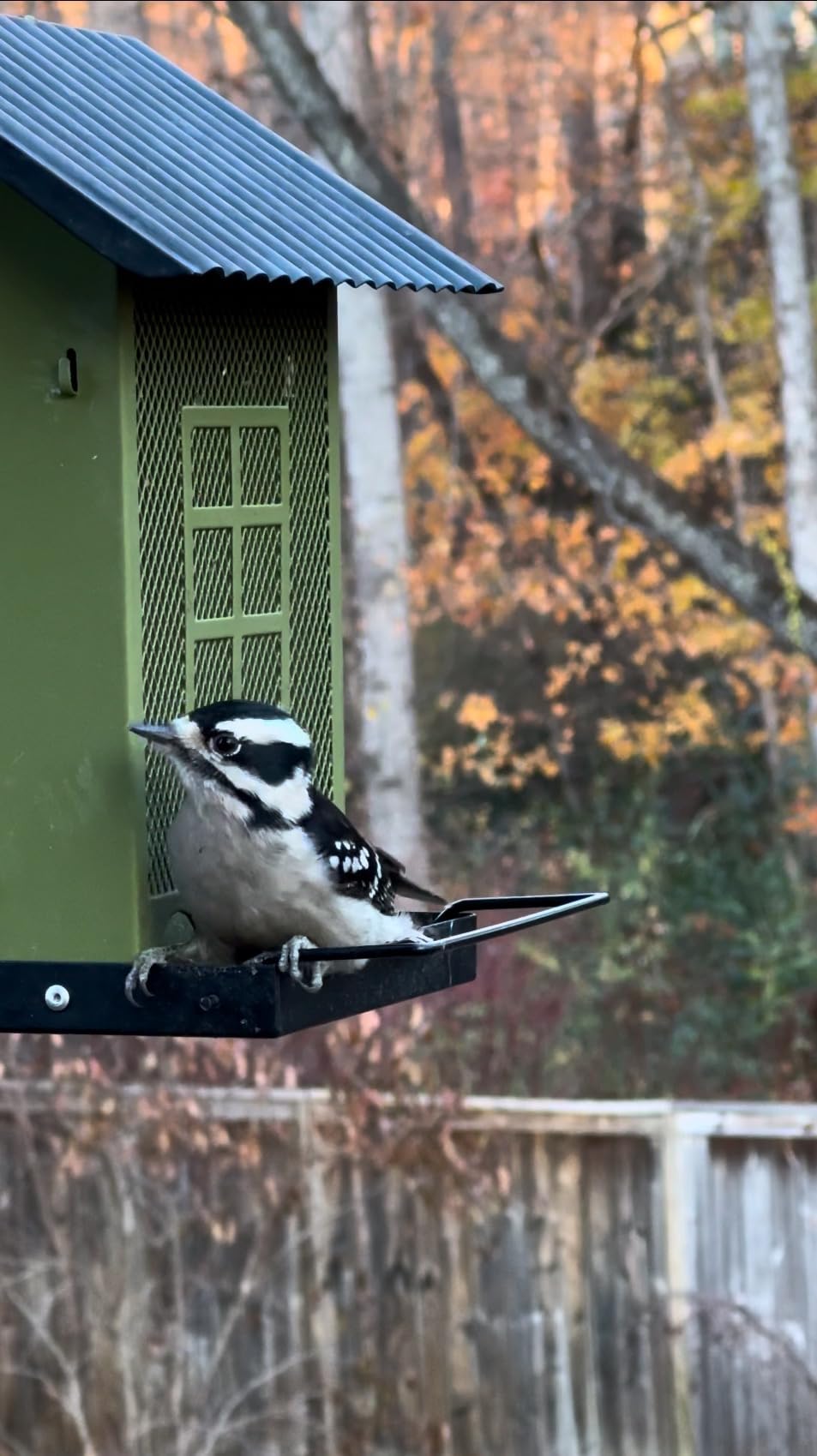
In the American continent, bird feeders have become a common facility in many home courtyards, parks, and green spaces. They not only provide a window for people to observe birds up close, but also provide important energy supplements for birds during food scarce seasons such as winter. However, a question worth exploring always exists: when humans observe birds feeding through bird feeders, will this "watching behavior" interfere with the normal state of birds and thus affect their emotions? To answer this question, it is necessary to explore the three dimensions of bird perception ability, behavioral adaptation mechanism, and specific human activities, combined with the research conclusions of behavioral ecology and actual observation cases, in order to comprehensively sort out the correlations among them.
1、 The perception boundary of birds towards human 'viewing': not all observations will be perceived
Firstly, it needs to be clarified that the response of birds to "human observation" is contingent upon their ability to perceive human presence and attention. There are significant differences in visual and auditory sensitivity among different species of American birds, which directly determines their ability to perceive human observations.
From a visual perspective, most songbirds (such as the American goldfinch and the main Cardinals) have a wide-angle field of view, with their eyes located on either side of their head, allowing them to simultaneously observe movements in front, sides, and even behind. However, they have lower sensitivity to "static observation". If humans observe from a distance of 3-5 meters away from the bird feeder and do not make sudden limb movements (such as waving or quickly getting up), these birds often do not see it as a threat - their brains are more inclined to be alert to "moving predators" (such as eagles and cats) rather than stationary humans. On the contrary, raptors (such as the red tailed pheasant, which occasionally visits bird feeders to capture small birds) have stronger visual focusing abilities and can clearly recognize subtle movements of humans in the distance. However, they usually do not consider humans as prey or predators unless humans actively approach their habitat.
From an auditory perspective, birds have a more complex response to human sounds such as speech and camera shutter sounds. Research has shown that birds that are often in human activity areas (such as urban parks) gradually adapt to low-frequency human sounds, and even associate "human sounds near bird feeders" with "food sources". In this case, human soft conversations do not trigger their anxiety; But for birds that inhabit remote forests and have less contact with humans, such as the forest thrush, even a slight sound of footsteps may immediately stop feeding and fly away from the bird feeder - this reaction is not "emotional anger", but a "risk avoidance behavior" based on survival instincts.
2、 The potential impact of human viewing behavior on bird emotions: the duality of positive and negative
If birds clearly perceive human viewing, will their emotions be affected? At present, research in behavioral ecology generally believes that this impact is not a single "negative interference", but depends on the "distance, frequency, behavior patterns" observed by humans and the "adaptation level" of birds themselves, presenting a dual nature of positive and negative coexistence.
(1) Potential positive effects: emotional "comfort" and "conditioned reflex pleasure"
Under long-term, regular, and gentle observation patterns, human viewing behavior may even have an "emotional soothing" effect on birds. For example, a long-term tracking study conducted by the Ornithology Laboratory at Cornell University in the United States found that in suburban households, if the same household is observed quietly at the same location (such as by the window) every day, after 2-3 weeks of adaptation, the local main Cardinals and Blue Jays will gradually reduce their vigilance towards the human - they will eat normally under human gaze, and even stay on the bird feeder to comb their feathers after eating (a typical manifestation of a relaxed state of birds). Researchers analyze that the essence of this phenomenon is that birds form a conditioned reflex between "human static viewing" and "stable food supply": when they see familiar humans in fixed positions, their brains secrete trace amounts of "pleasure related neurotransmitters" (such as dopamine), which are not "liking humans" but positive feedback on "safe food environments".
In addition, for some migratory birds (such as the yellow rumped warbler), if they can find food next to the bird feeder provided by humans during long-distance migration, and human observation behavior is gentle (no chasing, no noise), they will recover their energy faster - this experience of "quickly obtaining energy in a safe environment" will reduce their anxiety caused by "hunger and fatigue" and indirectly improve their emotional state.
(2) Potential negative impacts: emotional "anxiety" and "stress response"
When human viewing behavior exceeds the "safety threshold" of birds, negative effects will be significantly highlighted, mainly manifested as "anxiety emotions" and "stress reactions". This situation often occurs in the following three scenarios:
Close and sudden observation: If humans get too close to the bird feeder (less than 2 meters away), or suddenly step out of hiding (such as quickly appearing from behind a tree), birds will instantly enter a "stress state" - they will tighten their bodies, stop eating, rapidly rotate their heads to observe human movements, dilate their pupils, and slightly erect their feathers (a defensive posture ready to take off at any time). At this time, the heart rate of birds will sharply increase, and their bodies will secrete "cortisol" (a stress hormone). The long-term accumulation of this hormone can cause them to experience "emotional anxiety", specifically manifested as: frequent looking up to observe while eating, unable to concentrate and eat enough; Even if there is sufficient food, it will shorten their stay time and frequently shuttle between the bird feeder and nearby branches - this "fragmented feeding" can affect their energy intake, which may lead to weight loss in the long run and indirectly affect their reproductive behavior.
Watching with "threatening actions": If humans wave their hands, throw objects (such as stones, breadcrumbs), or use flash photography while watching, they will be judged as a "potential threat" by birds and trigger strong "fear emotions". For example, a volunteer once used a flash to take photos of a falcon visiting a bird feeder in the Americas. The falcon immediately flew away and did not appear next to the feeder for a week thereafter - this "fear memory caused by human behavior" can lead birds to have negative associations with the environment near the feeder. Even if humans stop inappropriate behavior later, they will need more time to readjust, and the anxiety during this period will continue to affect their normal foraging rhythm.
Excessive and frequent "spectator" observation: If the bird feeder is located in a public place (such as a park square) and there are a large number of humans stopping to watch every day (such as more than ten people gathering next to the feeder at the same time), even if everyone remains quiet, the birds will still experience anxiety due to "peer competition+human group pressure". For example, at a public bird feeder in Central Park, New York, researchers observed that when the number of onlookers exceeded 5, sparrows that would have stayed for 10-15 minutes would shorten their feeding time to 3-5 minutes and frequently engage in aggressive behavior with their peers during feeding. This "group watching" brought about environmental pressure, which could put birds in a "tense state" and prevent them from enjoying the normal feeding process. In the long run, it may lead to them abandoning the feeder and losing an important source of food.
3、 How to balance "human viewing needs" and "bird emotional protection": scientific suggestions for using bird feeders
Based on the above analysis, we can conclude that human viewing behavior near bird feeders in the Americas does not necessarily affect bird emotions - the key is whether humans can respect the survival habits of birds and establish a "gentle, regular, and safe" observation mode. To achieve this balance, the following suggestions can be considered:
Control the observation distance and maintain a "safety buffer zone": adjust the observation distance according to the size and alertness of birds - for small songbirds (such as goldfinches), the recommended observation distance is not less than 3 meters; For medium-sized birds (such as blue jays), it is recommended to be no less than 4 meters; For raptors such as red falcons, it is recommended to be no less than 10 meters. If observed indoors (such as by a window), it can be indirectly observed through glass. This "physical isolation" will make birds feel more secure and significantly reduce their anxiety.
Maintain the "stability" and "gentleness" of observation behavior: try to fix the observation position and time as much as possible (such as observing by the window at 8am every morning), and avoid frequent changes in observation locations; Avoid sudden standing up, waving, and making loud noises during observation, and do not use flash photography - a stable behavioral pattern can help birds quickly adapt to human presence and reduce stress reactions caused by "unknown changes".
Avoid "excessive feeding" and "excessive watching": The amount of food fed by the bird feeder should be moderate (preferably enough to be eaten every day) to avoid attracting too many birds to gather due to food surplus, which may lead to intensified competition among the same species; If the bird feeder is located in a public place, "observation signs" can be set up to guide people to observe separately (such as keeping a distance of more than 5 meters from the bird feeder and not gathering), reducing the impact of group pressure on bird emotions.
Respect the "escape signal" of birds and stop observing in a timely manner: If birds show obvious "anxiety signals" during the observation process (such as frequent head raising, body tightness, or preparing to take off), they should immediately stay away from the bird feeder or return indoors - this is a basic respect for the emotions of birds and the key to avoiding their "fear memory".
4、 Conclusion: The 'win-win' situation between humans and birds - guarding emotional balance through observation
The value of bird feeders in the Americas lies not only in providing humans with opportunities to get close to nature, but also in building a bridge for mutual adaptation between humans and birds. Watching birds feeding through bird feeders does not necessarily interfere with their emotions: when we observe in a respectful, gentle, and regular manner, birds gradually adapt to this presence and even consider it a part of the "safe environment", forming a harmonious scene of "human bird watching and bird feeding"; Only when we exceed the safety threshold of birds and interfere in a "greedy, rough, and disorderly" way, will we trigger their anxiety and stress reactions.
Ultimately, the emotions of birds are not "imperceptible abstract concepts", but rather "survival state feedback" clearly presented through their behavior (feeding duration, grooming feathers, whether they fly away). As observers, our responsibility is not only to 'appreciate the beauty of birds', but also to' safeguard their emotional balance in the human environment '- only in this way can the American bird feeder truly become a witness to the harmonious coexistence between humans and nature, rather than a' tool 'that interferes with the lives of birds.
Does the American bird feeder affect the emotions of birds when humans observe their feeding behavior through bird feeders
Sep 3, 2025 Bird knowledge presenters