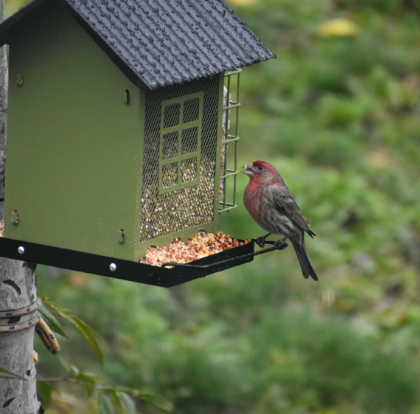
As a special ecological space where cities and nature intersect, American courtyards frequently face multiple interferences such as human activities, natural enemy invasions, and environmental changes. The birds living here have developed a precise and diverse behavioral adaptation mechanism through long-term evolution, which not only ensures their own survival but also becomes an important manifestation of the resilience of the courtyard ecosystem.
1、 Dealing with human activity interference: a 'compromise strategy' from avoidance to adaptation
Human activities are the main source of disturbance in American gardens, including daily walking, gardening work, pet activities, mechanical noise (such as lawn mowers, hair dryers), etc. The response behavior of birds exhibits obvious "gradient adaptation" characteristics:
Space avoidance and time imbalance: Common courtyard birds such as Cardinalis cardinalis and Haemorhous mexicanus actively adjust their activity range - the lawn area where humans frequently move is only used for short-term foraging, and core behaviors such as nesting and resting are transferred to the middle layer of shrubs and trees at the edge of the courtyard. At the same time, they will adjust their schedule synchronously: they complete their main foraging before the peak of human activities in the morning (such as 5:00-7:00), and then engage in secondary foraging when human activities decrease in the afternoon, avoiding the mechanical operation period at noon.
Behavioral desensitization and "risk assessment": Birds that live in densely populated human areas for a long time will gradually lower their response threshold to low threat human behavior. For example, the house swallow (Hirundo rustica) builds its nest under the eaves 1-2 meters away from human windows and shows "no response" to daily indoor activities such as walking and opening windows; But when humans approach the nest area less than 0.5 meters, they will immediately initiate defensive actions (such as hovering at low altitude and making rapid calls). This "graded response" mechanism not only reduces unnecessary energy consumption, but also enables timely response to high-risk disturbances.
Using human facilities to avoid danger: Some birds will transform human objects into "safety barriers". For example, Junco hyemalis builds nests in flower pots and corners of tool rooms in the courtyard, using human objects to block and reduce the probability of natural enemies discovering them; Turdus migratorius, on the other hand, will briefly stop on the balcony railings of human activities, using human presence to drive away some small predators (such as squirrels).
2、 Dealing with natural enemy interference: a clearly defined "defense system" with clear division of labor
The natural enemies of birds in American courtyards include raptors (such as peregrine falcons and red tailed pheasants), small mammals (such as raccoons and domestic cats), reptiles (such as black mouse snakes), and so on. Birds have evolved targeted defense behaviors based on the hunting methods of different natural enemies
Airborne surveillance: Group monitoring and signal transmission: When raptors such as peregrine falcons approach, sparrows (Passer domesticus) and spinus tristis in the courtyard will activate the "group surveillance system" - the first individual to detect the natural enemy will emit a high-frequency "warning song", and the remaining individuals will quickly stop their activities, hide in dense branches and leaves, or fly in the opposite direction of the natural enemy. This behavior not only protects the group, but also reduces the hunting accuracy of raptors through "noise interference".
Ground defense: Nest protection and camouflage: When facing surprise attacks from ground predators such as raccoons and domestic cats, birds will adopt a dual strategy of "active defense+camouflage". For example, Thryothorus ludovicianus builds its nest at the tips of twigs or in dense thickets of thorns, using terrain to hinder natural enemies from climbing; At the same time, the parent bird will lay dry grass and bark around the nest that are similar in color to the environment, reducing the visual exposure of the nest. If the predator approaches the nest area, the parent bird will perform a "tiger leaving the mountain" - pretending to have injured wings, slowly flapping on the ground, guiding the predator away from the nest, and suddenly taking off and escaping after being chased by the predator for a certain distance.
For reptiles: precision attack and environmental exploitation: When reptiles such as black rats and snakes attempt to climb trees and approach the nest, the thrush and blue raven (Cyanochita cristata) will adopt a "coordinated attack": multiple birds take turns diving, pecking at the snake's head and eyes with their beaks, or scratching the snake's scales with their claws; At the same time, they intentionally guide snakes to human activity areas (such as courtyard paths) and use human unintentional interference (such as footsteps or tool touches) to force snakes to escape.
3、 Coping with environmental changes and disturbances: a flexible and adaptable "survival strategy"
The environmental disturbance of American courtyards also includes seasonal temperature fluctuations, changes in food resources, extreme weather (such as rainstorm and snowstorm), etc. Birds adapt to these dynamic changes through behavioral adjustments:
Food Shortage Response: Dietary Expansion and Storage Behavior: During winter when food is scarce, backyard birds will significantly expand their feeding habits. For example, birds of the Oriole family (such as the Yellow rumped Willow Oriole), which usually feed on insects as their main food, will turn to feeding on grains and berries fed by humans; Blue ravens, on the other hand, have an instinct for "food storage" - they bury acorns and nuts in the soil or hide them in tree holes in their yards, storing 1-2 at each location, while remembering the locations of hundreds of storage points to accurately retrieve them during winter food shortages and ensure energy supply.
Extreme weather response: microenvironment selection and cluster heating: when rainstorm comes, birds will choose a specific microenvironment in the courtyard to shelter from rain - such as the middle layer of dense trees (high density of branches and leaves, less rain infiltration), under the eaves of human houses, garage corners, etc; In blizzard and low temperature weather, small birds such as sparrows and house sparrows gather in sheltered areas of the courtyard (such as bushes and gaps in walls) to reduce heat loss through "group heating". The group size can reach 10-30 individuals, and their body temperature can increase by 2-3 ℃ compared to individual individuals.
Temporary habitat adjustment: Short distance migration and resource tracking: When the vegetation in the courtyard is damaged due to pruning, pests and diseases, birds will undergo "short distance dispersal" - for example, the North American Cardinals, which originally built nests in the courtyard trees, will migrate to similar vegetation in surrounding parks and neighboring courtyards; After the vegetation in the original courtyard is restored, return to the original area to avoid energy consumption and risks of long-distance migration.
4、 Common characteristics of behavioral adaptation: energy efficiency and risk balance
Regardless of the type of disturbance, the behavioral strategies of courtyard birds in the Americas follow the core principles of "maximizing energy efficiency" and "minimizing risk":
Low risk interference: Minimize response: Low threat interference such as long-distance observation and slight noise to humans. Birds usually only show "brief alertness" (such as looking up for 1-2 seconds), and then resume normal activities to avoid energy consumption due to overreaction;
Medium risk interference: Adaptive adjustment: For example, in human gardening operations and the long-distance appearance of natural enemies, birds will respond by adjusting their activity space, time, or behavior patterns (such as pausing foraging and transferring to safe areas) to balance their survival needs and energy consumption;
High risk interference: Full defense: When deadly threats such as natural enemies' raids or extreme weather occur, birds will activate the highest level of defense behavior (such as group counterattacks and emergency shelters), not sparing a lot of energy to ensure survival.
This "graded response" mechanism is the key to the long-term survival and reproduction of American courtyard birds in human dominated ecological spaces - they neither completely escape from the human environment nor passively endure disturbances, but actively adjust their behavior to find a dynamic balance between "human activities" and "natural needs", becoming highly resilient "adaptors" in urban ecosystems.
We recommend our Flowafoli bird feeder!